The Elements of Art Form the Basic of Art
Do you know an answer to a question What are the elements of art exactly? Traditional way of looking at art, namely the visual arts, suggests that there are v basic elements of an art piece of work – line, shape, color, texture and infinite. You might observe form singled out equally a split up category, defined every bit a 3-dimensional culling to shape. Some also mention value, which is described as a parameter that determines the intensity of color, and design, which refers to repetition. As you can already imagine, these are supposed to exist the basic units deployed to constitute a visual arrangement, ultimately perceived as a whole.
Thanks to the manner our encephalon functions, nosotros rarely interpret these units individually, unless we deliberately choose to focus on each of them in item, or in instance the artist aims to emphasize a unmarried element in order to reach a certain consequence or to make a statement. The latter is a phenomenon more mutual for modernistic fine art, which emerged at the turn of the 19th century when the visual representation was challenged by an endeavor to deconstruct the existing assumptions which determined the style we sympathize the role of art and culture. Even if almost of today's art is not essentially based on the traditional forms of visual arts anymore, the elements of art continue to build our ocular perception. Hardly anything that belongs to the domain of the visual can be achieved without at to the lowest degree one of these elements.
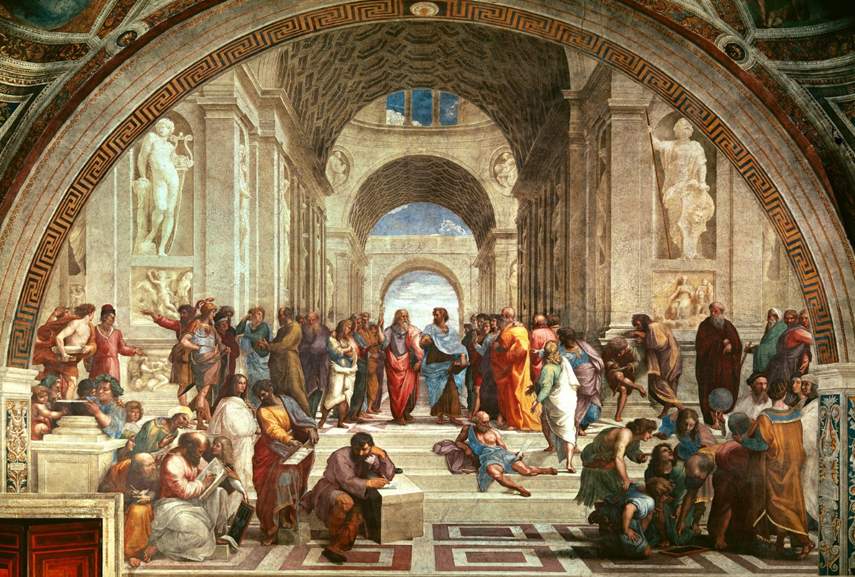
How We Use Line in Art
Maxim that the line is the most essential of all fine art elements somehow comes naturally. Subsequently all, it is commonly the first and the most pristine upshot of our contact with writing tools, pens, pencils, crayons, etc, and typically the commencement thing we choose to employ in order to represent the reality around united states. Even the occurrences that practice non have strictly outlined edges, such every bit the sun, the clouds or water, are depicted with lines rather than smudges of color in immature children'due south drawings. What this means is that lines are, in a style, our most valuable companions when information technology comes to expressing our feelings or thoughts, both for artistic and applied reasons. It is also a very interesting affair to discover and analyze, given that a line is, in general, an abstract phenomenon basically invented by humans.
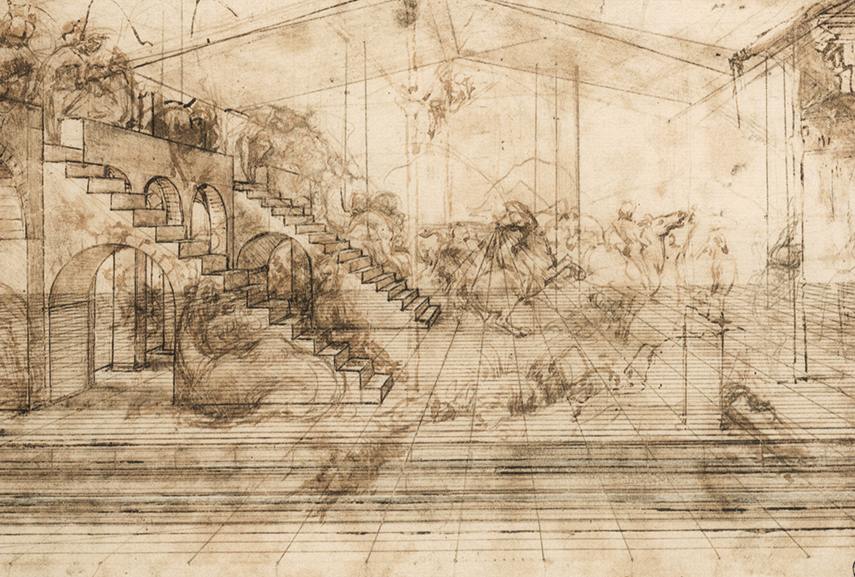
The Essence of Artistic Expression
A line is mathematically divers as a path that connects two dots or a path of an imagined moving dot. In reality, we tend to simplify all elements that are greater in length than in width, depth or diameter, and to perceive them as lines. This includes the things we encounter in everyday life that exhibit linear features, only also the phenomena nosotros perceive equally lines due to our vision, which is instructed by linear perspective. The way objects are arranged in space offers an paradigm that commonly consists of an endless number of various lines, fifty-fifty if these lines do not exist in physical space. An object adjacent to the surface of another, the outline of a figure against a afar landscape, the edges of mountains facing the sky – all of them present themselves as "lines", while in reality, they are much more or less complex. Nonetheless, the human capacity to interpret these visual stimuli into something as simple as a line attests to the significance of abstract thinking, and basically sums up the reasons why we are able to create something equally bogus, albeit nature-like, as art.
The line is specially of import for 1 other reason as well, and it is its potential to convey the personal touch of an artist. As discussed higher up, lines are the primary tools of creative expression, and therefore analogous to handwriting in terms of expressing individuality. A freeform line drawn by a unmarried individual is generally inimitable, which ultimately helps us recognize the author of a painting or a drawing when at that place is no name attached. A style of painting, brush-stroking, drawing or dripping is something each of us does differently. It makes a Picasso differ from a Braque.
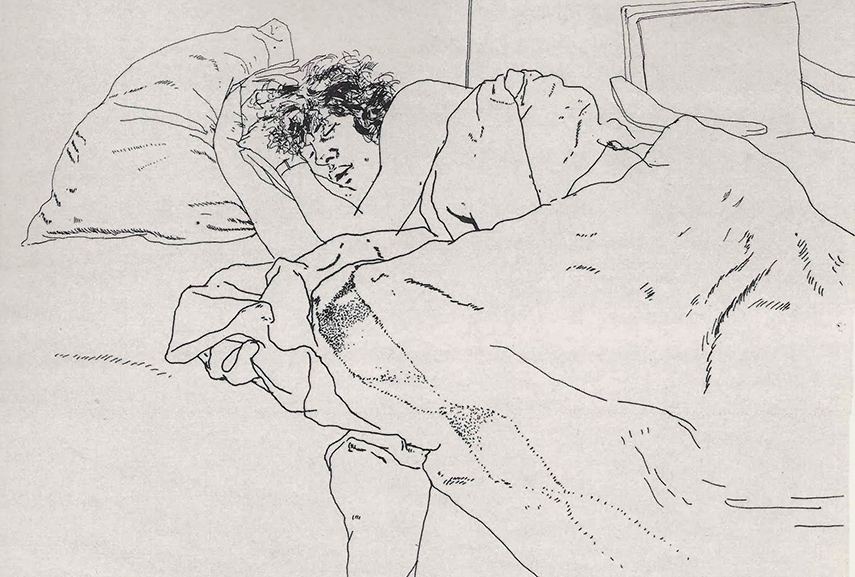
Examples of Shape and Form in Art
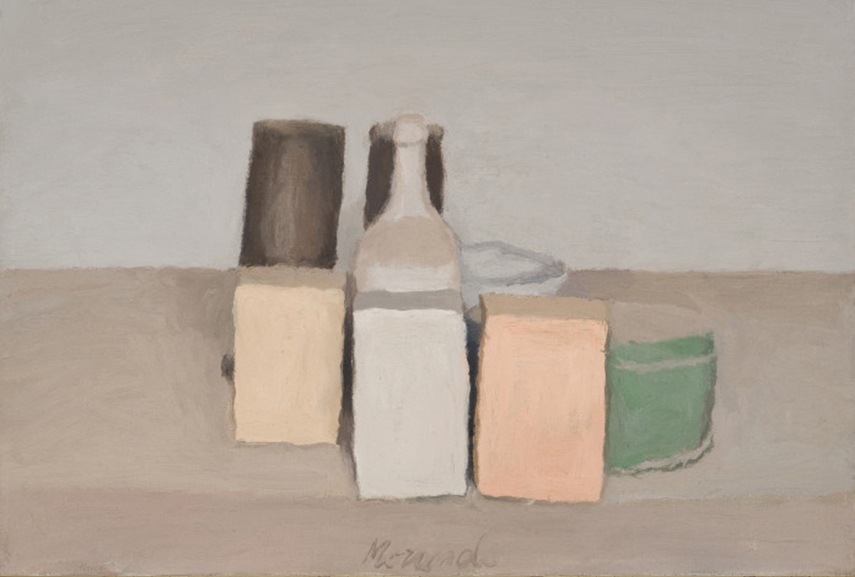
Once nosotros are able to recognize that a line is not just a line, but that it has a certain shape, it becomes, well – a shape. Shapes are defined as two-dimensional figures that we tin discern every bit familiar. These include geometric shapes (deployed past cubists, for case), organic (which you may detect among the examples of Art Nouveau posters and paintings), abstruse, etc. Grade, on the other hand, is a three-dimensional figure, meaning that information technology occupies a certain amount of space. The characteristics of shapes apply to forms as well, and the only difference is represented through the engagement of the third dimension (usually denoted as depth).
This means that fifty-fifty when a painting aims to illustrate a single form, such every bit a cube, for case, it actually depicts the shape taken upwards by the form, equally seen from a certain angle. It represents the cube's perceived book (which, from the forepart angle, turns out to be the square). Manifestly, form is much more frequently deployed in plastic arts, sculpture and architecture than in painting and drawing, yet the advice between the two – the shape and the class – is the crucial aspect of many art genres. Most of today's architecture would have never been built if at that place wasn't for it. Fifty-fifty more than patently, the ability to transfer forms into shapes on paper makes the most of the entire painting process.
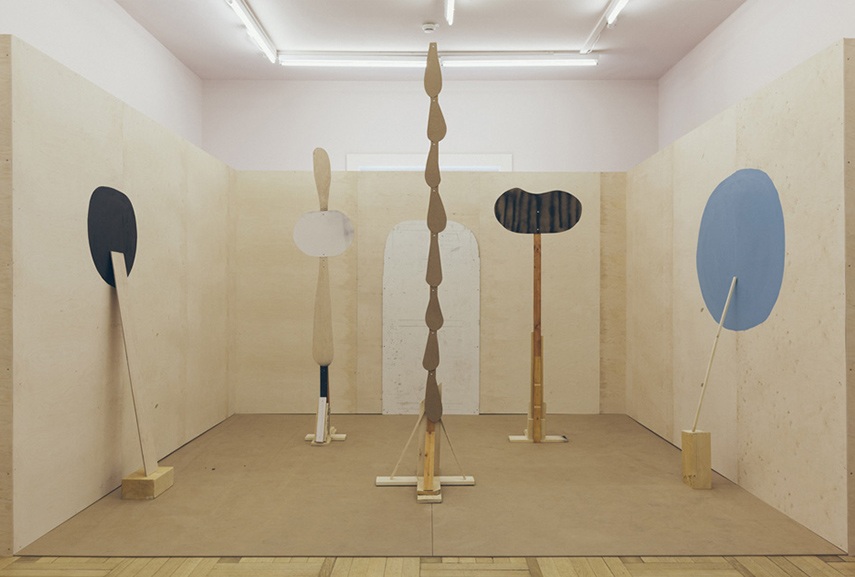
The Mode We See Different Shapes
There is one interesting ascertainment that examines the style we perceive certain shapes and why nosotros perceive them as such, for that affair. While the reference to the organic and the geometric ones should exist obvious – the former nosotros see in our natural surround, the latter was invented by humans themselves – our ability to recognize the abstract is not as easily explained. While growing upward and building feel, nosotros learn to observe or dismiss objects and their forms in time, meaning that our encephalon organizes the percept in our memory. This helps u.s.a. identify those that cannot exist named or attributed to the organic ones, and perceive closed or virtually-closed lines equally shapes, and not lines. The principle to organize particles into a whole, and to prefer the whole to a "sum" of units is what psychologists phone call Gestalt, which nosotros will get back to later in this article.
Space in Art
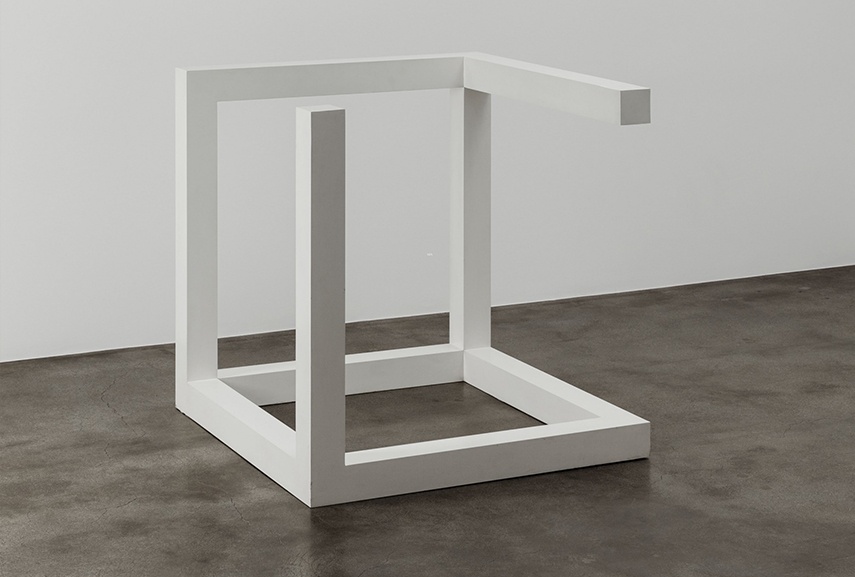
All fine art is placed within a certain space (aren't we all, in the terminate). But when it comes to visual arts, in that location are several ways in which nosotros tend to use the term space. Space is often illusively recreated in a painting or a drawing, realistically or in a distorted style. As much as the representation of space is an important part of all visual arts, especially when being trained for painting or when studying architecture for example, it is the to the lowest degree engaging mode to refer to the term as an art chemical element at this point, since information technology functions on the same principle as shape/form analogy does. At times, the discussion-space is used conditionally, to refer to the two-dimensional negative space left in the piece of canvas or paper. A "blank", or merely negative space, is sometimes a constituent part of an artwork, simply rarely in an explicit way. The intact part of the paper is very often deliberately left that manner, in guild to create the desired context and to suggest the right scale for observing the subject area matter, which thus occupies the so-called positive space.
The Physicality of the Created Space
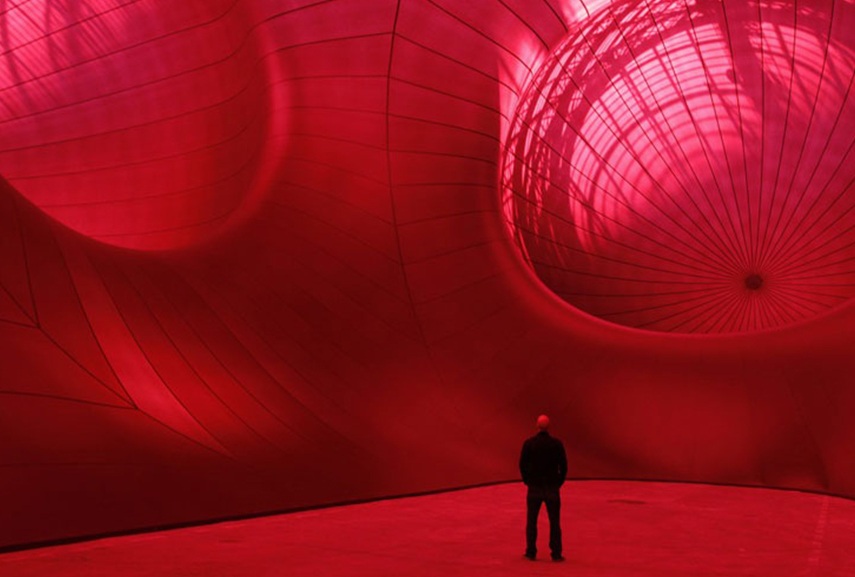
Of class, this illustration is derived from the existent, concrete infinite that nosotros inhabit as well. Consequently, a piece of fine art, be it a sculpture, an assemblage, an installation or even a painting, occupies a particular physical infinite with a certain purpose. Generally, the decision to surround a work of art with certain elements or to position it against a item backdrop is intentional and integral to the artwork. The distance from which we may be able to observe a painting and the possibility to circle around an exhibit are almost as relevant as the content of the artwork itself. This is specifically important for art installations, since the concepts behind them are usually site-specific, or at least site-suggestive, meaning that the venue is dictated by the grapheme of the installation. The idea of negative and positive space applies here every bit well, but information technology tends to create confusion when it comes to large-scale pieces and art installations. Ane of the masters of this inversion of negative space is Anish Kapoor, whose pieces often literally become the infinite itself.
"Sculpture isn't merely an object in space. Information technology lives through the processional or returning view. In a normal-scale object-a[northward Auguste] Rodin or [Donald] Judd for example, the living process is the walking around its 3-dimensionality. We're accustomed to the mise en scène in which the first view is the whole view, just you have to go along reviewing the medium, just equally you exercise with Rodin because the front of Balzac is not the same equally the back." - Anish Kapoor
Check out more than works past Anish Kapoor on our marketplace!
Color and Texture in Visual Fine art
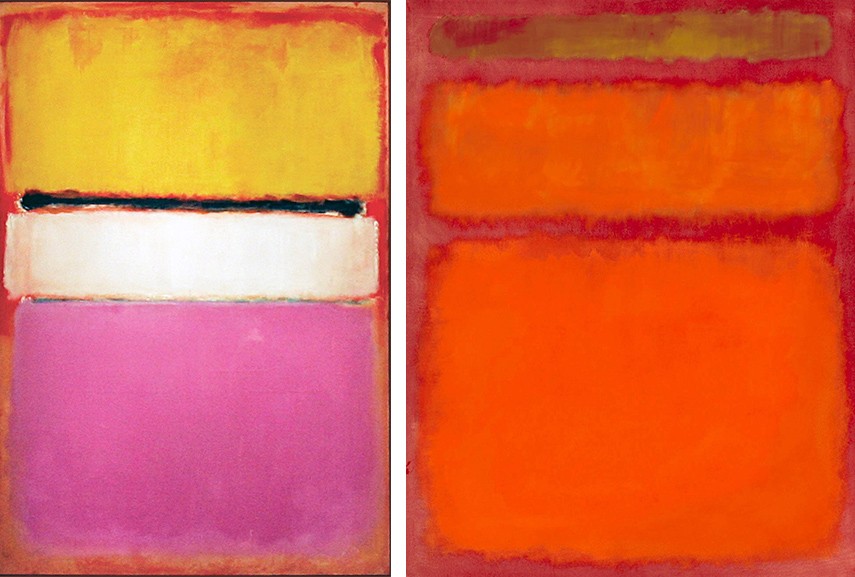
Finally, two qualities that strike us in everyday life and serve as an inexhaustible source of inspiration are color and texture, both of which have been studied, both in arts and scientific discipline, for centuries. Color is the light reflected off objects, perceived in different hues depending on the wavelength. Thanks to the and then-called cone and rode cells, our eyes are able to absorb the low-cal and to distinguish three channels of colors that consequently outburst into millions of tones, which makes our globe appear so beautiful and bright. Allegedly, colors are able to induce the widest range of emotions out all the visual art elements, which is why they are often seen as enigmatic and cryptic as if they truly possess a power to bear on our emotional state.
The apply of colors in gimmicky psychology is therefore numerous, as both through our feel and our innate physical responses each colour becomes associated with a variety of feelings, and lately even with certain social and political significations besides. The listing of artists who researched color and its implicit linguistic communication is quite a long one, and it involves the Bauhaus mystic Johannes Itten, the color-field painters Rothko, Newman and Klein, the minimalist Frank Stella and the Op Art pioneer Bridget Riley, the aforementioned Anish Kapoor… This could basically go on for hours, given that the significance and impact of color is crucial for arts, meaning that even when in that location is no color, it becomes a subject field of why there is no colour. Similarly, when the colors are not imitating the ones from real life, they express the creator'southward ain assessment of reality, given from a specific standpoint. For this reason, it was frequently incorporated every bit an element virtually apt to deliver a sentiment, either intuitively or intentionally. Every bit the fascination goes beyond art, people have been struggling to recreate pigments from nature, to synthesize unnatural values and tones of color, and even to see the "forbidden colors" that cannot usually be seen in nature.
Texture and the Materiality of an Artwork
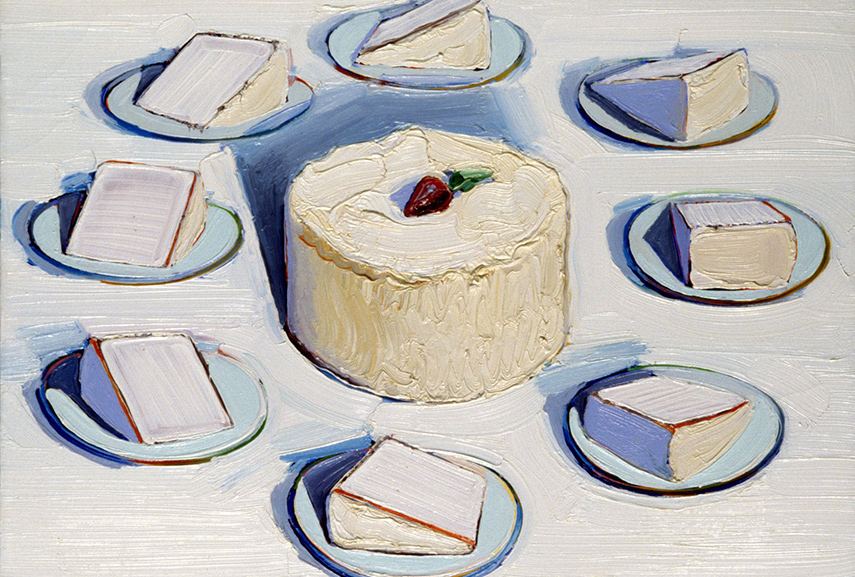
Texture is the quality of a surface, which is a sensation perceivable by the peel rather than the optics. However, we have been able to build a knowledge of how especially looking surfaces and materials feel, thank you to their palpable qualities and our feel with them. This ways that translating the characteristics of a surface onto a plane makes usa experience texture through vision, equally the painters exhibit their skill in representing the texture truthfully. Texture tin can also be a special quality relating to the trunk of painting itself, one that displays the visible castor strokes as an integral part of the painting, similar the 1 of Wayne Thiebaud beneath. Nonetheless, the concept of a fabric's roughness, softness or hardness is besides frequently seen in other media, such as sculpture. The illusion of the cloth's original quality is often accomplished by manipulating crafted materials, such as clay or forest. On the other hand, the artwork might exist playing with our expectations from information technology, since various materials are ordinarily used to create illusions of a texture that they do non possess - such every bit the increasingly popular marble-looking cream rubber in furniture pattern, or the transparent rock in the architecture of Kengo Kuma.
Elements of Art and Their Pregnant Today
Before we conclude this article, it would be useful to reflect on the bones art elements and their relevance to today's art and art teaching. At some point, the divergence between craft became desperate, and this "intellectualized" approach to art is a tendency that remains to this twenty-four hours. Withal, the ways of expressing an idea are still based on the capacities of human senses, which haven't changed significantly since the beginning of humanity as nosotros know information technology. The digitally informed environs might bring some improvements to our senses, or fifty-fifty some decreases for that matter, but until that happens, everything we are able to feel and experience is nonetheless going to be served for the same receptors, our eyes, our skin, and ears.
The Everlasting Change in Perception
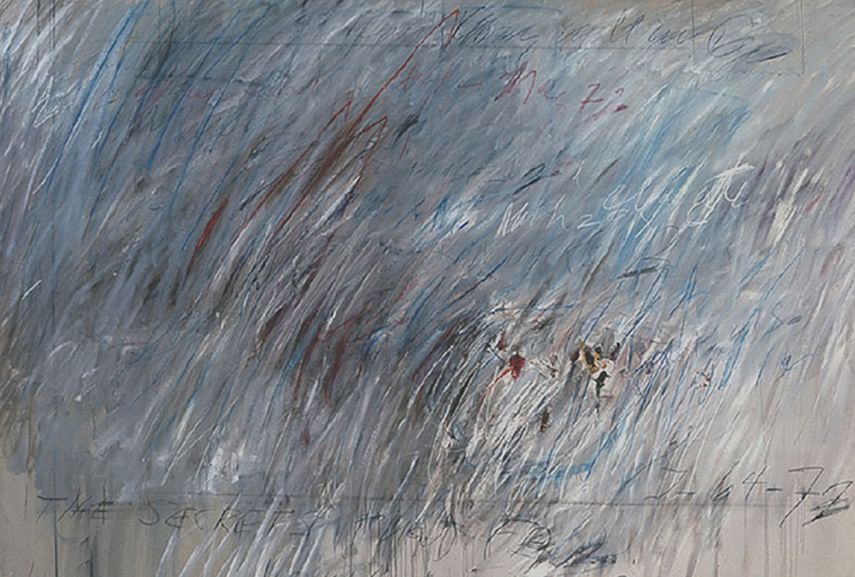
The subject matter and the way nosotros explore each of the elements of art changed over time, which led to an altered approach to these features. Gestalt psychology was mentioned in this text, due to its chief principle that points out how man perception acknowledges the whole as other than a sum of parts. Information technology recognizes the anthropological tendency to group like traits and to categorize information, to connect parts and to deduce significant rather than merely observe without contemplation. It could exist said that visual representation functions co-ordinate to this theory, but then does our cognitive ability to consider different ideas and phenomena.
Hence, information technology is of import to mention that modern art was a time of exploration, a time of departure from tradition, and as well a moment to abandon everything we know and to grasp the uncanny, which at times meant separating each of these elements and challenging the Gestalt. We can see the outcomes of these intents through many historical movements, such as De Stijl, the Bauhaus, Abstract Expressionism, Minimalism, and and then farther. The elements were finally reduced to their essential notions in abstract art. Finally, now that we've overcome the modern era, and probably the postmodern as well, nosotros are beginning to find new purpose for each of the archetype elements of art, aware of how they were reinvented in the era of modernism. This means that everything can be brought into question, and the possibility of a single meaning no longer exists, just like the post-structuralist philosophy suggests. Our beautiful visual world is richer than ever, then are the e'er-progressing means of representation.


Juhani Pallasmaa wrote The Eyes of the Skin in 1996, and information technology has become a classic of architectural theory. However, even though the book mainly centers around the question of why has ane single sense – sight – become so predominant in architectural culture and design, it may besides be perceived as a guidebook to understanding the power and nature of our five senses. Furthermore, it explains the principles on which our sight is based, and how nosotros managed to evaluate and visually guess the phenomena that do non speak to our eyes.
Featured image: Henri Matisse - La Danse (1909); Report of Two Dancers past Edgar Degas, charcoal, High Museum of Fine art. All images are for illustrative purposes only.
Source: https://www.widewalls.ch/magazine/five-elements-of-art
0 Response to "The Elements of Art Form the Basic of Art"
Post a Comment