Read Chapter 1: the Mechanical Universe From Galileo to Newton in Peter Dear's Intelligibility.
New Learning or Scientific Revolution?: Natural Philosophy from Galileo to Newton
It is often claimed that the seventeenth century saw i of the near important events in modern history: the Scientific Revolution. From this perspective, the Scientific Revolution is the pivot around which modernistic history turns, enabling scientific discipline to marginalize religion and enabling reason to overcome myth, paving the mode for the Enlightenment and the explosive political revolutions of the tardily-eighteenth century. Merely in fact, no ane in the seventeenth century thought this style. The name "Scientific Revolution" really dates to 1939, and entered into widespread usage just in the mid-1950s.[1] Even though many of the ideas discussed in this chapter were recognized every bit new, no ane at the time sought to break with the past, and new scientific endeavors were frequently inspired past ancient sources. Seventeenth-century science was heavily influenced past the medieval scholastic belief that nihil in intellectu quod non prius in sensu (Latin for "nothing is in the mind that is non get-go in the senses"). The events ofttimes associated with the and then-called Scientific Revolution merely continued to work out this much older commitment to empiricism. Debates nigh the reliability of sensory feel shaped the human relationship that scientific discipline had with both faith and technology. The results of scientific research were sometimes new, but the assumptions guiding them were oftentimes not.
Instruments and Methods
Can we trust our senses? This might seem like a strange question, but it is not. According to the historian of science Peter Honey, science has two faces. The kickoff is concerned with intelligibility, understanding how the world works. The 2d is concerned with instrumentality, using engineering science to improve understanding and and then applying that knowledge in a practical style.[two] Intelligibility and instrumentality became inseparable in the seventeenth century. Together they gave rise to modern empiricism, only too to a keen recognition that the senses have limits and tin can even deceive. On the 1 hand, all empiricism presumes that sensory data communicates something true and trustworthy about the earth; on the other hand, scientific knowledge today is impossible without the aid of technology such as microscopes—and however, microscopes reveal precisely how much our eyes fail to see. No less important, the successful use of scientific instruments requires training, because without the requisite skills, the senses are non, in and of themselves, adequate for successful scientific inquiry. Empiricism is cipher if not paradoxical.
The telescope is among the most well-known seventeenth-century scientific instruments. Originally called the spyglass, it was invented in 1608 by Hans Lipperhey (1570–1619), a Dutch spectacle maker, and was intended for navigation and war machine use.[three] The telescope was not yet ii years sometime when Galileo Galilei (1564–1642) used it to first report the heavens. In doing and so, he was quite unconventional—and the novelty of his inquiry was greeted with considerable skepticism. During Easter 1610, after an intensive, two-calendar month menstruation using his telescope to written report Jupiter'south moons, Galileo gathered a group of natural philosophers together in Rome. Quite confronting Galileo'due south expectations, those who used his telescope that night were not only incapable of seeing Jupiter's moons, but came to regard his telescope as a failure. They agreed that in its ability to magnify objects on Globe, information technology was better than Lipperhey'southward original, but they dissented from Galileo'south belief that the telescope could as well be used to accurately study the heavens. In particular, they denied that, with it, 1 could see four moons around Jupiter. In the words of 1 attendee, "On Globe it works wonders; in the heavens it deceives."[4] Those who rejected Galileo's claims did so for a simple reason: they trusted their senses.
The problem surrounding the discovery of Jupiter's moons was ultimately a elementary one: few had been trained to utilize the telescope, and nonetheless fewer were trained to employ it for astronomical inquiry. Even astronomers inspired past Galileo's inquiry initially had their doubts. Attempting to verify Galileo's widely doubted discovery, Johannes Kepler (1571–1630) and his associate Benjamin Ursinus (1587–1633) spent the first nine days of September 1610 trying to replicate Galileo's observation. Just on their 9th consecutive dark were they both able to verify the moons. By the end of the year, others had also confirmed Galileo'south discovery. Perhaps Galileo was a bit naïve; having worked with his telescope for months, he expected others to verify his findings in a single night with an instrument that none were trained to apply. But information technology is besides difficult to mistake Galileo or his colleagues for their respective stances. All involved believed what they did—and didn't—see. This early contend about the reliability of the telescope was conducted firmly inside the bounds of seventeenth-century empiricism. Equally section IV of this chapter will further discuss, teamwork, correspondence, and an emerging academic readership both drove and refined the contents of such intellectual disputations.
Despite initial doubts, consensus about Jupiter's moons grew comparatively quickly. The shape of Saturn was a very different thing. Nearly immediately after observing Jupiter, Galileo turned his telescope to Saturn, concluding that it was actually a composite of iii different planets (encounter fig. 1). Here, too, Galileo'south conclusion conflicted with before consensus, but dissimilar the moons of Jupiter, defoliation over Saturn's shape reigned for more than than half a century. In 1659, Christiaan Huygens (1726–1695) published his Systema Saturnium (Latin for "The Arrangement of Saturn"), in which he offered a new theory about Saturn'southward shape, proposing—correctly, as information technology turned out—that the planet had a band around it. At this fourth dimension, Huygens was i of Europe's premier manufacturers of telescopes, and he rejected earlier descriptions of Saturn by arguing that they were the product of inferior telescopes. Here was another example of a scientist arguing against the consensus, and some found Huygens's blowing presumptuous. Having spent decades studying Saturn with telescopes other than Huygens's own, should other astronomers have suspended conventionalities in their own observations and simply accustomed Huygens'southward conclusions? Consensus well-nigh Saturn's shape developed very slowly over the course of many decades and only subsequently much research. In the seventeenth century no less than today, consensus took time.
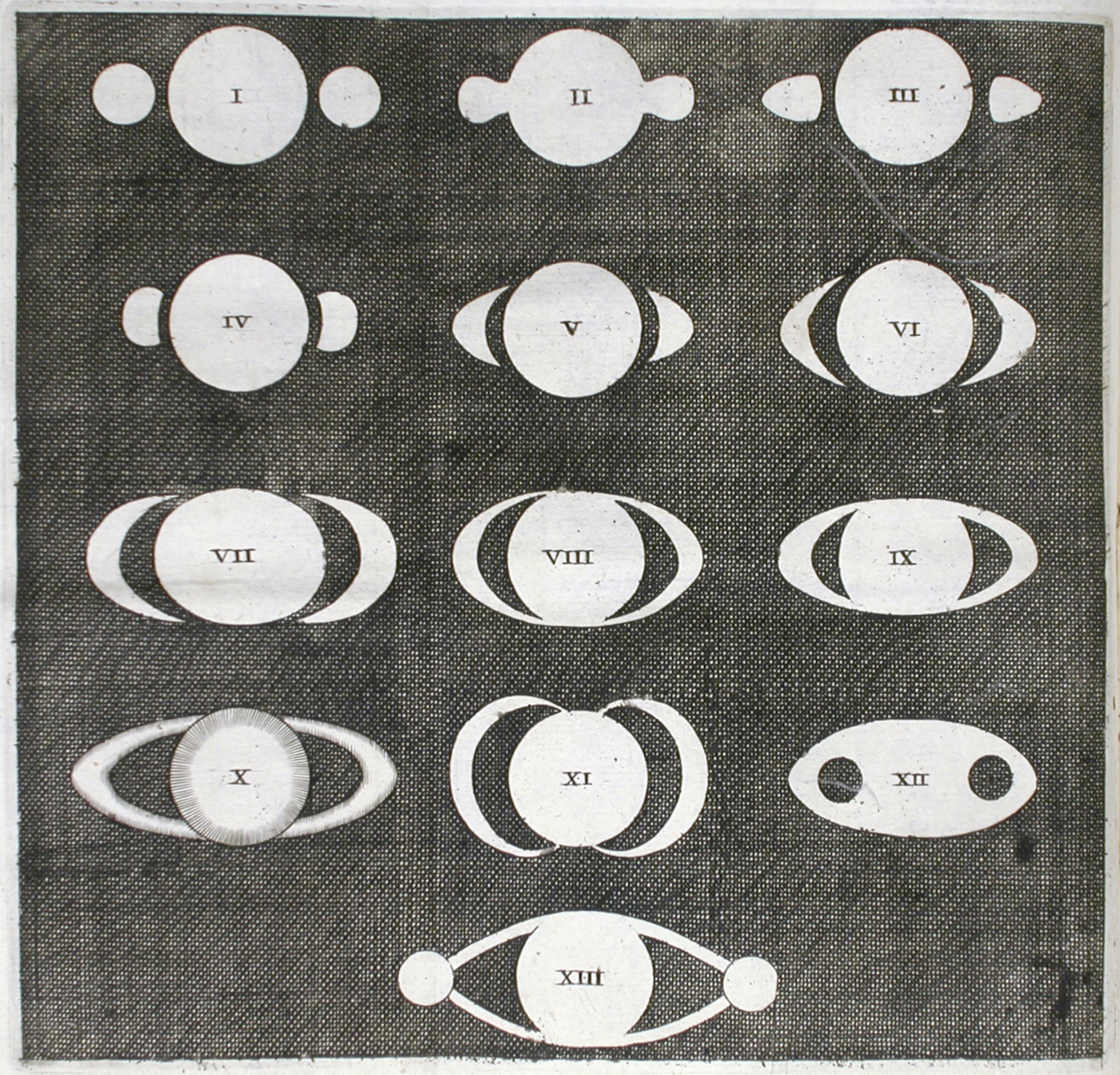
Effigy 1. The changing appearance of Saturn, from Christiaan Huygens, Systema Saturnium (The Hague: Adriaan Vlacq, 1659), 35. Image courtesy History of Scientific discipline Collections, University of Oklahoma https://lynx-open up-ed.org/index.php/node/504
New instruments facilitated new discoveries; they also demanded new inquiry methods. The English polymath Francis Bacon (1561–1626) arguably provided the most expansive and detailed program for scientific experiments in his 1620 work Instauratio Magna (Latin for "The Neat Renewal"). Its frontispiece, which shows a ship set to ready sheet, reveals Bacon's belief that his method would yield important discoveries (see fig. 2). The second part of this work, the Novum Organum Scientiarum (Latin for "The New Instrument of the Sciences"), laid out Bacon's thoughts on experiments. Beseeching divine aid, while eschewing what he chosen the "violent attacks from the military of opinion," Salary advocated "marriage betwixt the empirical and rational faculties."[five] Not unlike Galileo's early on critics, Bacon believed that the senses could deceive, but he also believed that experimentation provided a reliable mode out of this predicament. Salary privileged experiments over instruments, writing, "the subtlety of experiments is far greater than that of the senses themselves fifty-fifty when assisted past carefully designed instruments; we speak of experiments which have been devised and practical specifically for the question under investigation with skill and proficient technique." Insofar as an experiment remained open to comeback, it would yield a fully reliable empiricism. The senses would become "sacred high priests of nature and skilled interpreters of its oracles."[six] In Bacon's work, skepticism about the reliability of the human senses did not atomic number 82 to a denigration of human intellectual aspiration, merely to a remarkably high view of the capacities of human effort.
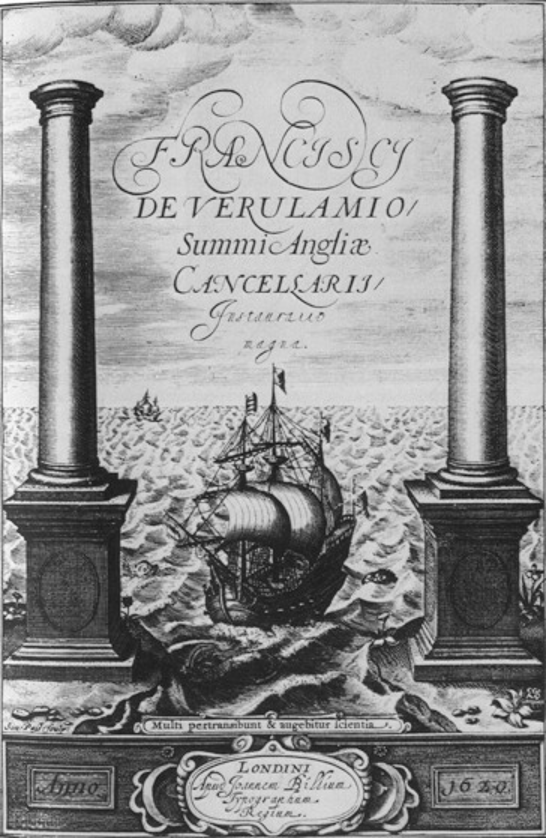
Figure two. Frontispiece, from Francis Bacon's Instauratio Magna, published in 1620. Public Domain.
All of this might audio revolutionary and new, but Salary actually aimed at the renewal of lost noesis. He was partially inspired by the Jewish myth of Seth's pillars. In the Biblical book of Genesis, God's jiff gives Adam life. It was widely accepted in aboriginal Jewish and Christian idea that with God'due south jiff came special knowledge, and that this was reflected past Adam's power to name all of the animals in the Garden of Eden. When Adam ate the forbidden fruit of the Tree of the Knowledge of Good and Evil, his divinely inspired noesis began to decay, but he transmitted what he remembered to his son Seth, who inscribed this noesis upon pillars of stone. With Noah's overflowing, the pillars were destroyed and the knowledge scattered—just information technology was not lost. The experimental method advocated in Novum Organum was non simply about discovering new cognition, but about recovering and restoring the fragments of Adam's once-perfect understanding. Hence the title of Bacon'south larger project: the Great Renewal. Hoping to catalogue "every novelty, rarity or aberration in nature," Bacon concluded Novum Organum with a list of 130 unlike topics for future investigation.[7] Some of his suggestions might strike modern readers as curious. With no hint of irony, Salary advocated investigating sleep and dreams, the history of music and other arts, and fifty-fifty the importance of composing a "History of Jugglers and Clowns."[8] However odd some of his suggestions might seem, they conduct witness to the remarkable latitude of Bacon's vision—a vision that, equally we will see, had profound influence.
No doubt much of this seems quite familiar, but some very dissimilar assumptions were held at the fourth dimension about mathematics and physics. Quite dissimilar today, at the dawn of the seventeenth century, mathematics was not seen as integral to scientific work. Before the seventeenth century, there had been little reason to question the importance of the demonstratio potissima (Latin for "the strongest demonstration"), an argument in formal logic known as the syllogism. Aristotle held that a syllogism was perfect if its determination followed self-evidently from 2 premises: "All A are B, all B are C, therefore all A are C." Mathematical demonstration was not considered capable of producing an argument as strong as the demonstratio potissima because mathematics, equally something abstract, is not capable of the kind of certainty revealed through sensory experience. Mathematics deals in quantitative relations—and very few people at the time accepted that quantitative relations could explain physical causes and furnishings. In this regard, it is important to recognize that at least some of Galileo's experiments may have never been performed; they were more similar idea experiments. But could thought experiments, even if their conclusions were justified on the basis of mathematical demonstration, provide a sure understanding of the natural society?
Cosmologies
When Galileo began using his telescope, there were several major theories virtually the shape of the universe. The get-go was geocentrism, which placed the Globe at the center, and which is oft associated with the ancient philosopher Ptolemy. The second was heliocentrism, which placed the sun at the heart, which slowly became the dominant astronomical model. Although Nicolaus Copernicus (1473–1543) did not invent heliocentrism, he gave it a sophisticated explanation, but one that was largely ignored until the late sixteenth century. The third model was geoheliocentrism, which placed the sun, Mercury, and Venus in orbit around the Globe, just placed all other planets in orbit around the sun. Advanced by Tycho Brahe (1546–1601), who worked out this arrangement in the 1580s, geoheliocentrism was more than pop than the other ii systems throughout much of the seventeenth century.
Before going any further, a popular myth about geocentrism should be dispensed with. It is sometimes believed that geocentrism and heliocentrism functioned as claims about humanity's place in the universe. Co-ordinate to this version of history, some Christians—such as the members of the Roman Inquisition—believed that moral order mapped cosmological order. They allegedly dedicated geocentrism because they believed that humanity's importance necessitated existing at the eye of the universe; thus heliocentrism was incorrect because, in removing humanity from the center, information technology as well degraded the value of human beings. In fact, no one argued this.[ix] Contemporaries connected cosmological centrality not with moral importance but with inferiority. It was widely held that, like God, stars and planets were more perfect and not subject to modify, whereas mutability and entropy defined terrestrial existence. They further believed that because the Earth was the axis of a centripetal universe, it was also a receptacle for the universe's detritus.[ten] At a more metaphorical level, centrality could likewise indicate suffering, as seen in Dante Alighieri's (1265–1321) Inferno, where the center of hell was located in the center of the Earth, and thus was at the very center of the geocentric universe. Centrality was hardly a privileged position! In fact, proponents of heliocentrism often made moral arguments in favor of their system, arguing that displacing Earth from the heart of the universe better accorded with Christian behavior in the moral value of humanity. Heliocentrism sometimes doubled as a moral claim; geocentrism and geoheliocentrism did not.
At a scientific level, heliocentrism was rejected for several reasons. First, it lacked explanatory ability. In his two-volume 1651 masterpiece Almagestum Novum (Latin for "New Almagest"), the most important mid-seventeenth-century synthesis of astronomical research, Giovanni Battista Riccioli (1598–1671) collected 126 arguments almost heliocentrism; 77 of these were arguments for geocentrism, while 49 were arguments for heliocentrism.[11] Riccioli was off-white-minded and noted that each side in this argue had a number of plausible counterarguments to use against its opponent. But Riccioli found a small number of arguments against heliocentrism decisive. One of these was the merits, beginning made past Tycho Brahe, that the orbit of the Globe should produce noticeable effects on Earth. Heliocentric arguments held that the Earth rotated on an axis as it orbited the sun. This meant that at the equator, the Earth rotated faster than it at its poles. Borrowing from Brahe, Riccioli proposed that if the Earth were really rotating, so firing a cannon ball northward would cause the cannon ball to deflect east of the intended target. Problematically, cannon balls could not be observed deflecting this way—and thus, Riccioli ended, geoheliocentrism was the more than plausible argument.
A second key argument against heliocentrism concerned annual parallax, the credible modify in the size of stars due to the position of the Earth in its orbit effectually the dominicus. Copernicans and their opponents both agreed that stars, similar the sun, did not move. This raised a problem for proponents of heliocentrism: if stars are fixed, they should appear progressively larger as the Earth orbits closer to them, and smaller as the Earth orbits abroad. Problematically, such changes could not be seen. Anti-Copernicans recognized this, and emphasized the point; Copernicans could non counter their objection. Considering the orbit of planets such as Jupiter and Saturn was appreciable but annual parallax was not, information technology made far more sense to assume that the Earth besides did non move. Consequently, heliocentrism remained a topic of argue long after Galileo, and a affair of astute interest decades after Riccioli compiled the 126 arguments in the New Almagest. In 1674, Robert Hooke (1635–1703), 1 of the earliest members of the Royal Lodge, considered almanac parallax the single most of import anti-Copernican argument. The frontispiece of the New Almagest shows heliocentrism and geoheliocentrism weighed against each other in a scale (see fig. three). The geoheliocentric organization wholly outweighs the heliocentric organisation, thus indicating that Riccioli considered it more plausible, and that he invited his readers to do the same.
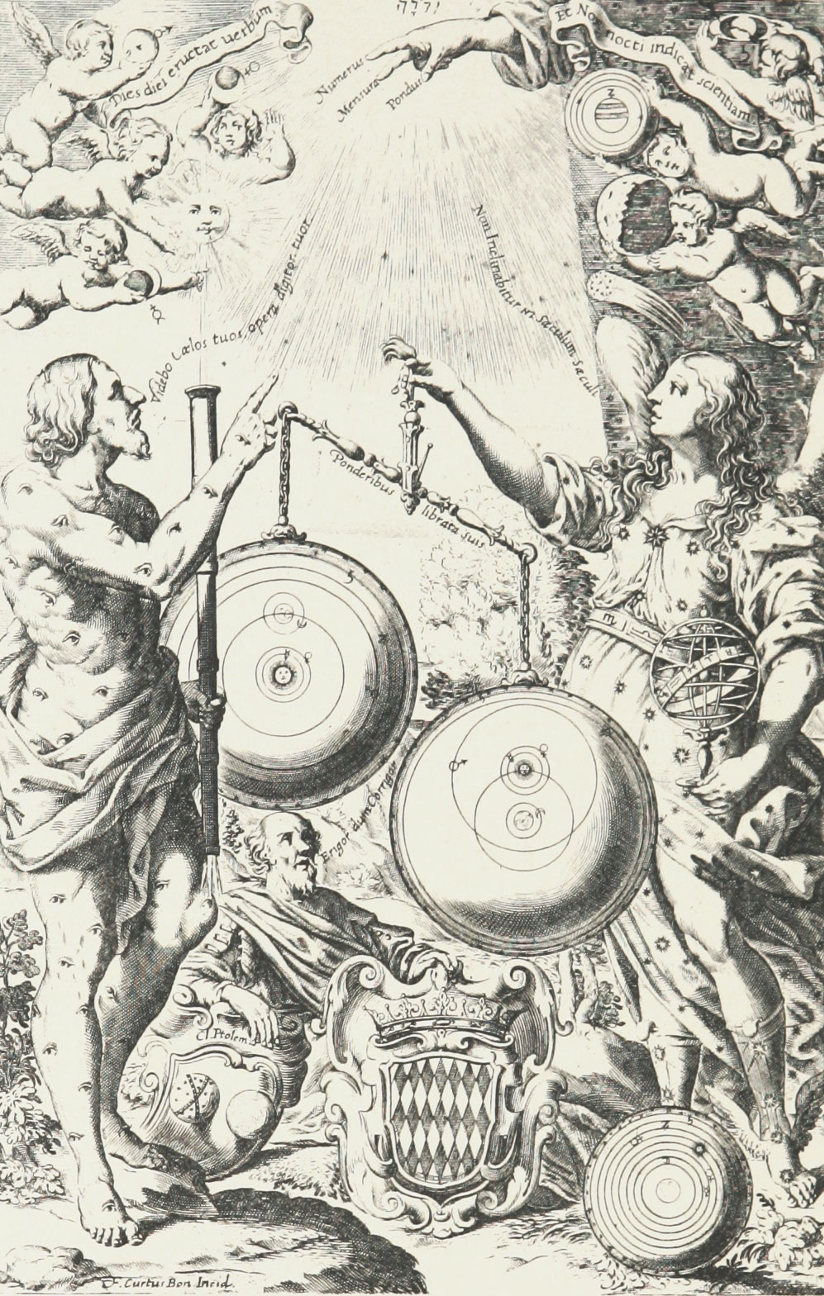
Figure 3. Frontispiece of Riccioli'due south New Almagest (1651). Public Domain.
Religion
Related to the issue of cosmology is the issue of religion, but as the preceding give-and-take indicates, the relationship between religion and science was more complex than is often assumed. Disharmonize between science and religion is most often associated with Galileo, but an of import caveat must be noted. Seventeenth-century arguments near the structure of the universe did non fall into a simple bifurcation with religion on i side and natural philosophy on the other. Galileo did non accelerate purely scientific arguments, and his detractors did not counter him with purely religious responses. Debates near heliocentrism were not zippo-sum contests betwixt scientific discipline and organized religion, but were instead about how to understand the harmony between them. Everyone believed that true scientific cognition and true religious conventionalities were complementary.
The nearly popular metaphor for describing the relationship between organized religion and nature was "God's two books." The commencement book was the Christian Bible and the 2nd was the Book of Nature, a metaphorical clarification for the entire natural club. This metaphor was inherited from earlier centuries and carried with information technology a sense that the two books were already distinct, even though God was held as the writer of both. The seventeenth century did not come across a change in this basic conviction, simply instead a slowly developing belief that particular methods were appropriate to the study of each. As Galileo wrote in his lengthy "Letter to the G Duchess Christina," "I think that in disputes about natural phenomena one must brainstorm non with the authority of the scriptural passages but with sensory experience and necessary demonstrations."[12] Like his contemporaries, including his opponents, Galileo believed that the Bible was divinely inspired and that God sometimes accommodated divine revelation to the finite intellectual capacities of human beings. But when it came to studying the natural order, scripture was less important than direct investigation of the Volume of Nature. Half a century later, Robert Boyle (1627–1691), a deeply religious Irishman and member of the Royal Society, articulated a similar view. For Boyle, studying nature aided religious contemplation, but the study of nature had to proceed according to experiment and ascertainment. Religious activeness gave natural philosophy an almost mystical value, but religious affections could not direct the methods and conclusions of scientific investigation.
Theological reflection often punctuated scientific publications, and even at its nearly rigorous, scientific enquiry was not simply the effect of dispassionate observation. Results were sometimes buttressed with explicitly theological claims. Galileo's "Letter to the Thousand Duchess Christina" was a modest theological treatise about the relationship betwixt Biblical interpretation natural philosophy. Something similar is true of Kepler, who proposed that heliocentrism offered a more perfect prototype of the Trinity than geocentrism. Kepler compared God the Begetter with the sun, the Son of God with the moon, and the Holy Spirit with the air between them. Those who argued for geoheliocentrism besides made theological claims: Brahe justified geoheliocentrism by appealing to both the Bible and the results of his observations. But, as already noted, heliocentrism remained problematic because its proponents could non answer key empirical objections to information technology. Faced with such difficulties, Copernicans often resorted to a religious statement: that their observations revealed the absolute ability of God. Opponents of heliocentrism countered that this was a flight from all observational demands, and that highly-seasoned to theology without observational data effectively rendered scientific work irrelevant.
No 1 believed that religious arguments were, in and of themselves, capable of determining scientific matters. Those who rejected Galileo's findings often described Copernicanism as "contrary to Holy Scripture," but if we focus on this statement alone, nosotros volition fundamentally misunderstand the full scope of debate virtually heliocentrism. Then as at present, scientific consensus was a matter of considerable importance. The Roman Inquisition, which condemned Galileo on June 22, 1633, offers an first-class example. Its judgment confronting Galileo referred beginning to scientific agreement against heliocentrism. Simply subsequently this did it turn to religious matters. The Roman Inquisition decreed,
That the dominicus is the centre of the globe and motionless is a proposition which is philosophically absurd and fake, and formally heretical, for being explicitly contrary to Holy Scripture;
That the earth is neither the center of the world nor motionless but moves even with diurnal motion is philosophically equally absurd and false, and theologically at to the lowest degree erroneous in the Faith.[13]
All sides involved believed in the harmony of religious and scientific truth. Perhaps surprisingly, the Roman Inquisition's sentence against Galileo is among the clearest statements of this conviction.
Religious ideas sometimes also helped inspire scientific ventures. In his fictional piece of work New Atlantis (1626), Francis Salary sketched out the major outlines for what became the Royal Society. In this story, a group of English explorers comes upon the fictional land Bensalem (Hebrew for "son of peace"). They learn that Bensalem has a learned society chosen Solomon's House. Here Bacon borrowed from the Hebrew Scriptures (the Old Attestation); Solomon was the wisest rex in ancient Israel, and had received his wisdom as a miraculous impunity from God. The rex of Bensalem founded Solomon's House in 300 BCE "for the finding out of the true nature of all things (whereby God might have the more than glory in the workmanship of them, and men the more than fruit in the utilise of them)."[14] This parenthetical remark perfectly summarizes Bacon'southward vision. On the one hand, it presumes the integration of religious faith with philosophical noesis. On the other paw, and no less chiefly, information technology also presumes that philosophical noesis is fundamentally applied and oriented toward human well-being.
New Atlantis was not just a work of fiction. Bacon was partially inspired by the utopian literature that developed and grew in popularity following the discovery of what Europeans termed the New World. Utopian works were oft prescriptive, portraying a meliorate (if fictional) society in society to critique their ain culture. Consequently, New Atlantis also engaged in advocacy. A good example is when Bacon had the inhabitants of Bensalem draw Solomon'south House to their English visitors every bit "the very eye of this kingdom."[15] By holding Bensalem up in this manner, Salary hoped that his English contemporaries would create and value a learned order of their own. Bacon's narrative further justified the purpose and research methods used by such a society. As one member of Solomon'due south House informed Bacon's readers, "The Stop of our Foundation is the knowledge of Causes, and underground motions of things; and the enlarging of the bounds of Human Empire, to the effecting of all things possible."[16] This was not a perspective unique to New Atlantis; Bacon advocated the aforementioned in Novum Organum, writing that "In religion we are taught that faith is shown by works; and the same principle is well applied to a philosophy, that it be judged past its fruits and, if sterile, held useless."[17] Solomon's Business firm thus oversaw a vast number of projects, from apothecaries to zoos, ensuring that the results of its researches were bachelor to each and every citizen. Some projects detailed in New Atlantis reflected larger seventeenth-century concerns. 1 good example is "perspective-houses," which sought to "procure means of seeing objects afar off; as in the heaven and remote places."[18] Other projects were unique to New Atlantis, such as "sound-houses, where nosotros practice and demonstrate all sounds, and their generation."[nineteen] By envisioning a inquiry-based academic community aimed at helping society every bit a whole, Salary laid much of the intellectual background for the Regal Gild, which was established in 1660.
- The Purple Lodge
The Royal Social club is the oldest scientific society in the world. At its first coming together on November 28, 1660, the members resolved to create "a Colledge for the promoting of Physico-Mathematicall Experimentall Learning." Charles 2, king of England, Scotland, and Ireland, granted a lease for its incorporation in 1662, and in 1663 the "Colledge" became known equally the Imperial Lodge of London for Improving Natural Cognition. Ii years later, the society began publishing Philosophical Transactions, the world's first scientific journal. With the exception of a lapse in publication betwixt 1678 and 1683, Philosophical Transactions has been in print always since. Peer-reviewed, publishable research is the cornerstone of all modern scientific scholarship, and in this the Royal Society was the not bad trailblazer. Intellectual teamwork and academic publications were vital for the society's success. Perhaps unsurprisingly, like organizations soon developed in French republic and in other European nations, often patterning themselves upon the Royal Society.
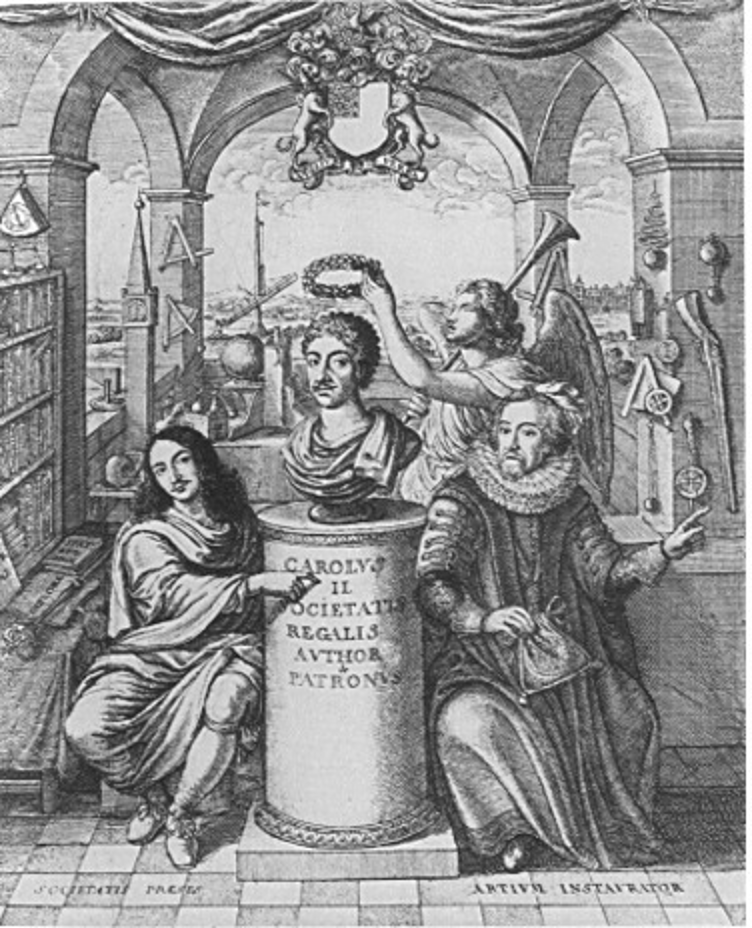
Figure 4. Frontispiece of Thomas Sprat's History of the Royal Gild.Public Domain.
Much can be learned about the early on epitome of the society by reading Thomas Sprat's (1635–1713) 1667 History of the Royal Gild. Its frontispiece shows Francis Bacon on the right; on the floor before him are the words "Artium Instaurator" (see fig. four). The Latin can be translated in several ways because the Latin word "ars" translates as "arts," "sciences," and "skills" ("artium" is the plural possessive form of "ars"). Bacon was thus named "The Renewer of the Arts/Sciences/Skills." To the left of the bust is the first president of the society, William, Viscount Bouncker (1620–1684). The Latin on the bust translates as "Charles Two, Author and Patron of the Royal Society." An angel places a laurel wreath, signifying both victory and political rule, upon Charles Ii'due south head. Meanwhile, the background is filled with scientific and mathematical instruments. This might audio similar a scientific revolution, but Sprat was just as eager to celebrate the past. He adjusted Salary's paradigm of the restoration of learning and gave information technology a historical narrative, tying restoration to comparatively recent events such as the invention of the printing press and the Reformation. At every step, Sprat advocated the advocacy of knowledge, and yet, like Salary, he looked back to antiquity likewise. In a department entitled "The Recovery of the Antients," Sprat wrote that in the advocacy of learning, "The First thing that was undertaken, was to rescue the excellent works of former Writers from obscurity."[twenty] Greek and Latin philosophers, together with the Bible and the Church Fathers, headed Sprat's list of works.
Some early publications by members of the Majestic Gild restate many of the themes already touched on in this chapter. Hooke, one of the Royal Society'south earliest members, began his 1665 work Micrographia with a lengthy reflection on method, the senses, and the importance of scientific instruments. He informed his readers, "The starting time thing to exist undertaken in this weighty work, is a watchfulness over the failings and an inlargement of the dominion of, the Senses."[21] Micrographia was entirely concerned with the experiments that Hooke had carried out with various magnifying spectacles. Upon recognizing the limits of the senses, he advised that, "The side by side care to exist taken, in response of the Senses, is a supplying of their infirmities Instruments, and, as it were, the adding of artificial Organs to the natural."[22] Telescopes and microscopes were among the "artificial Organs" that Hooke named. Applied science and empiricism were as key—and as complicated—in late-seventeenth-century England equally they had been in early-seventeenth-century Italia.
In other means, the Royal Lodge did things that were genuinely new. One was the creation of Philosophical Transactions. Another was the evolution of a more refined vocabulary for describing the work that took place under the more general heading of "natural philosophy." In 1661, Robert Boyle coined the term "mechanical philosophy." It operated with the working assumption that the universe was a kind of machine, total of matter in motion, and that events were explainable with reference to mechanical causes. The master outlines of this line of inquiry had developed in the decades earlier 1661, but despite Boyle'southward influence, the early Royal Society primarily framed its research in terms of "experimental philosophy," thus privileging method equally primal to its aims. Isaac Newton (1643–1727), arguably the early on Imperial Order's most famous member, came to distinguish quite firmly between "experimental philosophy" and what he termed "hypothetical philosophy." The goal of the former was "to find out by experience & ascertainment not how things were created simply what is the present frame of Nature."[23] The word "hypothesis" has changed significant between Newton'south fourth dimension and our own; at the time, it referred to something divorced from feel rather than something testable. Hypotheses were non necessarily untrue in Newton's thought, they simply did non vest to experimental philosophy.
Through Newton, the Royal Society bequeathed a third major development to the wider world. Newton's abiding gift was placing mathematics at the heart of scientific study. This is well seen in the title of his most famous work, the 1687 Philosophiae Naturalis Principia Mathematica (Latin for "The Mathematical Principles of Natural Philosophy"). Newton revised this text several times, and its import brings the story of this affiliate full circumvolve. As already noted, one early dispute with Galileo had concerned whether mathematical explanations were purely hypothetical or if they instead revealed something true about nature. With Newton, mathematics took its place in natural philosophy. In the Principia, Newton introduced universal gravitation and his three laws of motility. Although the story of Newton's apple may exist a myth, he did develop a way to measure gravity mathematically even though he could not fully explain how it worked. Not all were convinced by Newton'south dependence on mathematics. Gottfried Wilhelm Leibniz (1646–1716) was, with Newton, one of the discoverers of calculus and thus fully committed to the use of mathematics, just Leibniz argued that without a distinctly mechanical account, Newton's explanation of gravity finer rendered it a hidden only supernatural force. Newton developed his distinction between experimental and hypothetical philosophy largely as an answer to Leibniz. It enabled Newton to sidestep the problem of mechanical explanation without neglecting mathematical bear witness. As the seventeenth century gave style to the eighteenth, mathematics ceased being a hypothetical thing. Information technology was revealed as the very fabric of nature.
Conclusion
So, was in that location a scientific revolution—or, were new forms of inquiry, discovery, and learning rather less sensational? It's non an like shooting fish in a barrel question, but some important points can be made in conclusion. The preceding sections have shown a broad variety of influences upon natural philosophers. Ancient sources, such every bit those central to philosophy and religion, were no less inspirational than discoveries such as the New World or the rings around Saturn. When discussing things that appear new, information technology is easy to miss the enduring presence of goods inherited from past ages. Just in fact, novel instruments and innovative methods enabled fresh approaches to what were often very old matters of interest and concern. No one denied the importance of empirical cognition, and the value of scientific research was understood as analogous to a very one-time religious concern with the performance of righteous works. Whether we phone call this a revolution or not, the scientific developments of this fourth dimension period were real, and some proved to exist of decisive long-term importance. That they often drew securely upon the past should non surprise anyone, for such is the nature of history.
[i]. Steven Shapin, The Scientific Revolution (Chicago: Academy of Chicago Press, 1996), 1ff., 168–70; John Henry, The Scientific Revolution and the Origins of Modernistic Science, 2nd ed. (New York: Palgrave, 2002), 1ff.
[two]. Peter Dear, The Intelligibility of Nature: How Science Makes Sense of the Earth (Chicago: University of Chicago Press, 2006), 1ff.
[3]. Rolf Willach, "The Long Road to the Invention of the Telescope," Transactions of the American Philosophical Gild, New Series 98, no. 5 (2008): 98–99.
[iv]. Cited in Albert van Helden, "Telescopes and Potency from Galileo to Cassini," Osiris 9 (1994), 8–29, at 11.
[5]. Francis Bacon, The New Organon, ed. Lisa Jardine and Michael Silverthorne (Cambridge: Cambridge University Press, 2000), 11, 12.
[6]. Bacon, The New Organon, 18.
[7]. Salary, The New Organon, 149.
[8]. Salary, The New Organon, 238n124.
[nine]. Dennis R. Danielson, "Myth 6. That Copernicanism Demoted Humans from the Center of the Cosmos," in Ronald L. Numbers, Galileo Goes to Jail and other Myths about Scientific discipline and Religion (Cambridge: Harvard University Printing, 2009), 50–58.
[10]. Michael Northward. Keas, "Myth 3. That the Copernican Revolution Demoted the Status of the Earth," in Ronald 50. Numbers, Newton's Apple and other Myths most Science (Cambridge: Harvard University Printing, 2015), 23–31.
[11]. For this and what follows, see Christopher 1000. Graney, Setting Aside All Authority: Giovanni Battista Riccioli and the Science against Copernicus in the Age of Galileo (Notre Dame: University of Notre Dame Press, 2015), esp. ch. 9.
[12]. Galileo Galilei, "Letter of the alphabet to the 1000 Duchess Christina," in Maurice A. Finocchiaro, The Galileo Affair: A Documentary History (Berkeley: University of California Press, 1989), 87–118, at 93.
[13]. "Sentence (22 June 1633)," in Finocchiaro, The Galileo Affair, 287–291, at 288.
[14]. Francis Salary, The Major Works, ed. Brian Vickers (Oxford: Oxford University Printing, 2002), 471.
[15]. Salary, The Major Works, 464.
[xvi]. Bacon, The Major Works, 480.
[17]. Bacon, The New Organon, Book I, LXXIII, 61.
[18]. Bacon, The Major Works, 484.
[19]. Salary, The Major Works, 485.
[xx]. Thomas Sprat, The History of the Royal-Society of London, For the Improving of Natural Knowledge (London: T. R. and J. Martyn, 1667), p.
[21]. Robert Hooke, Micrographia: Or Some Physiological Descriptions of Minute Bodies Fabricated by Magnifying Glasses with Observations and Inquiries Thereupon (London: John Martyn, 1665).
[22]. Hooke, Micrographia.
[23]. Cited in Alan E. Shapiro, "Newton's 'Experimental Philosophy'," Early Science and Medicine nine, no. iii (2004): 185–217, at 192.
Source: https://press.rebus.community/historyoftech/chapter/new-learning-or-scientific-revolution/
0 Response to "Read Chapter 1: the Mechanical Universe From Galileo to Newton in Peter Dear's Intelligibility."
Post a Comment